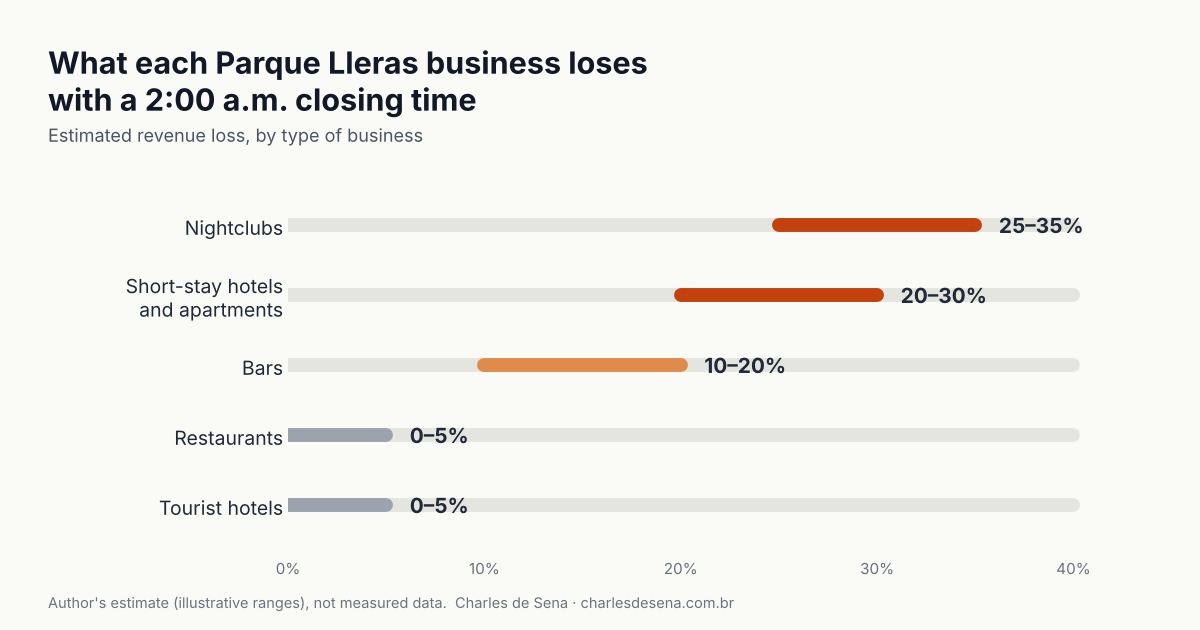
Medellín’s new zoning plan takes two hours away from Parque Lleras: nightlife businesses will close at 2:00 a.m. instead of 4:00 a.m. The rule doesn’t hit everyone equally, and it was designed that way. Businesses that live off the small hours lose a lot; those that live off dinner barely notice.
What changes
The City Council approved the revision of the POT (Medellín’s land-use and zoning plan) on November 5, 2026, with 18 votes out of 21. Parque Lleras moves from a high to a medium mixed-use zone, and the closing time for venues in the Convive la Noche program drops from 4:00 to 2:00 a.m.
The intent is written into the plan itself: prioritize restaurants, hotels, fashion, culture and neighborhood retail, and reduce nightclubs and other high-impact uses.
To estimate the impact, I used a simple formula for each type of business:
loss = share of revenue between 2:00 and 4:00 a.m. × share of those customers who don’t come earlier or spend more before 2:00 a.m.
The percentages below are order-of-magnitude estimates, not measured data. The scale, however, is real: at the end of 2024 there were 205 bars and nightclubs, 130 lodging businesses and 356 restaurants and cafés within 300 meters of the park, according to the city’s business registry, as I showed in my earlier analysis of Parque Lleras.
Nightclubs: the hardest hit
Estimated loss: 25% to 35%. A nightclub fills up after midnight, and bottle sales usually peak between 1:00 and 3:00 a.m. Cutting 2:00 to 4:00 a.m. cuts the most profitable part of the night.
Customers don’t make up for it by arriving earlier: people who go out dancing don’t move their night up by two hours. They go somewhere else. That makes Lleras nightclubs the most likely to close or relocate.
The effect on jobs will probably be larger than the effect on sales: with fewer full-house hours, the first cut is the late shift (bartenders, security, DJs, cashiers).
Short-stay hotels and apartments: they fall with the night
Estimated loss: 20% to 30%. Let’s be blunt. In Parque Lleras, “hotel” means two different businesses. One is the tourist hotel, which sells nights. The other is the short-stay hotel or apartment, which sells hours and lives off the same late-night flow: prostitution and encounters that start at the bar and end in the room.
For the second group the math is direct: fewer hours of open bars, less sex work on the street, fewer rooms rented by the hour. Their loss tracks the nightclubs’.
That’s no coincidence. Since 2024 the mayor’s office has targeted exactly this circuit, with decrees suspending the demand for sexual services in public spaces in Parque Lleras, Provenza, Calle 10 and Parque de El Poblado.
Bars: a moderate loss, with room to adapt
Estimated loss: 10% to 20%. A music and cocktail bar has a more spread-out night: it starts at happy hour and peaks before 1:00 a.m. The small hours matter, but they aren’t the whole business.
Some customers will come earlier if the bar gives them a reason: a longer happy hour, events at 9:00 p.m., live music early in the night. Bars that only lived off the after-club crowd lose more.
The bigger risk is the starting point. Asobares, the bar owners’ association, says only seven of its 24 member venues in the area remain, and business owners report sales drops of up to 90%. For a bar already operating on the edge, with Lleras rents, losing 15% can be the difference between staying open and closing.
Restaurants: barely affected, and they may gain
Estimated loss: 0% to 5%. Dinner ends well before 2:00 a.m. What’s lost is liquor sales at gastrobars that turn into bars after midnight.
The plan was designed in their favor. If the rule pushes part of the late-night crowd away and reduces noise and fights, the park could once again attract families, couples and tourists who avoid it at night today. It won’t be quick: Jorge Gómez, of Medellín Gourmet, estimated that a full recovery of the area could take three to five years if the private sector and the government work together.
Tourist hotels: small losses, possible gains
Estimated loss: 0% to 5%. They lose some guests who came for the party and wanted to walk back from the club. In return, hotels are one of the uses the plan wants to prioritize, and less late-night noise improves the stay for business travelers, families and couples.
Another rule may work in their favor: under the new plan, new short-term rentals can only be located in high mixed-use zones and transit-oriented development (DOT) areas; existing ones that meet all requirements can keep operating. If Lleras becomes medium mixed use, the Airbnb supply there stops growing and new demand goes to hotels. This is my inference: it still needs to be confirmed how the rule applies to the Lleras perimeter.
Summary
| Business | Weight of 2:00–4:00 a.m. | Recovery before 2:00 a.m. | Estimated loss | Likely outcome |
|---|---|---|---|---|
| Nightclub | High (40%–50%) | Low | 25%–35% | Close or move to Provenza or Manila |
| Short-stay hotel | High | Low | 20%–30% | Falls with the night |
| Bar | Medium (20%–30%) | Medium | 10%–20% | Move the night earlier |
| Restaurant | Low (5%–10%) | High | 0%–5% | Gain from a calmer park |
| Tourist hotel | Indirect | — | 0%–5% | Gain if Airbnb stops growing there |
The night doesn’t disappear, it crosses the street
In the extended-hours pilot for Halloween 2026, Provenza, Lalinde and Manila were on the list of allowed zones, and Parque Lleras was left out. If those zones stay high mixed use, many of the people who used to leave Lleras at 4:00 a.m. will just walk a few blocks. Lleras loses; El Poblado as a whole loses much less. And the problem the city wants to tackle may simply move to another street.
This has been tested before. In April 2024, decree 0247 closed Lleras at 1:00 a.m. Business owners said about 5,000 jobs were affected, and within ten days the city allowed venues to stay open until 3:00 a.m. again, as a 15-day pilot.
What we still don’t know
- When it takes effect. The plan takes effect once the mayor signs it and the agreement is published; no date has been announced.
- Whether there will be a transition period for venues currently open until 4:00 a.m.
- The exact perimeter that stops being high mixed use.
How to actually measure it
- Google’s popular times for 30 to 40 Lleras venues: how much of the crowd is still there after 2:00 a.m.
- Hourly sales from point-of-sale systems, through Asobares: the most accurate data.
- Compare Lleras with Provenza and Manila before and after the rule, to measure how much moves.
If you run a business in the area and want to run this exercise with your own data, get in touch.
Sources
- El Tiempo: City Council approves the new POT and ORP Urbanismo: Medellín’s new POT (2026)
- Minuto30: what the POT proposes for Parque Lleras
- Minuto30: key points of the new POT
- Minuto30: Santiago Quirós’s column on Parque Lleras (November 10, 2026)
- Minuto30: extended hours for Halloween
- City of Medellín: decrees against commercial sexual exploitation in El Poblado (2024)
- El Espectador: protest against decree 0247 (2024) and El Nuevo Siglo: closing time back to 3:00 a.m.
The loss percentages are the author’s estimates, not measured data.