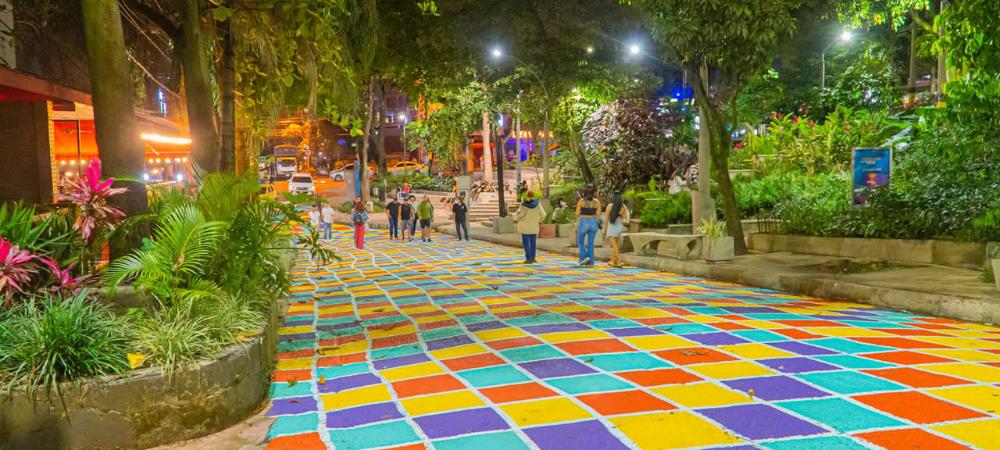
Parque Lleras, the heart of Medellín’s nightlife in El Poblado, is going through its worst moment in years. Asobares, the bar owners’ association, says that of the 24 member venues it had in the area, only seven remain. Business owners report sales drops of up to 90%. The mayor’s office points to 430 arrests since 2024 and 34 foreigners detained for child sexual exploitation.
Both versions can be true at the same time. But there’s one fact almost nobody mentions: Medellín’s public crime data ends in November 2023, and the public business registry in March 2025. The decrees, the large-scale police operations and the closures all came afterwards.
In other words, one of the city’s toughest urban interventions in recent years is being carried out without public evidence that would allow anyone to evaluate it. We don’t know whether the mayor’s office has that data and isn’t publishing it, or whether it isn’t measuring at all. Either answer should worry us.
The underlying question is whether we are fighting exploitation or just moving it somewhere else. Today, nobody outside the city administration can answer it.
This analysis uses the City of Medellín’s public business registry to look at Lleras before the crisis, organize what is known since, and point out what nobody can measure today.
Note: the charts and the interactive map are in Spanish, as in the original edition of this article.
Before the Crisis, Lleras Wasn’t Dying
A common belief is that the area was already in decline and that the measures only sped up the end. The data doesn’t support it.
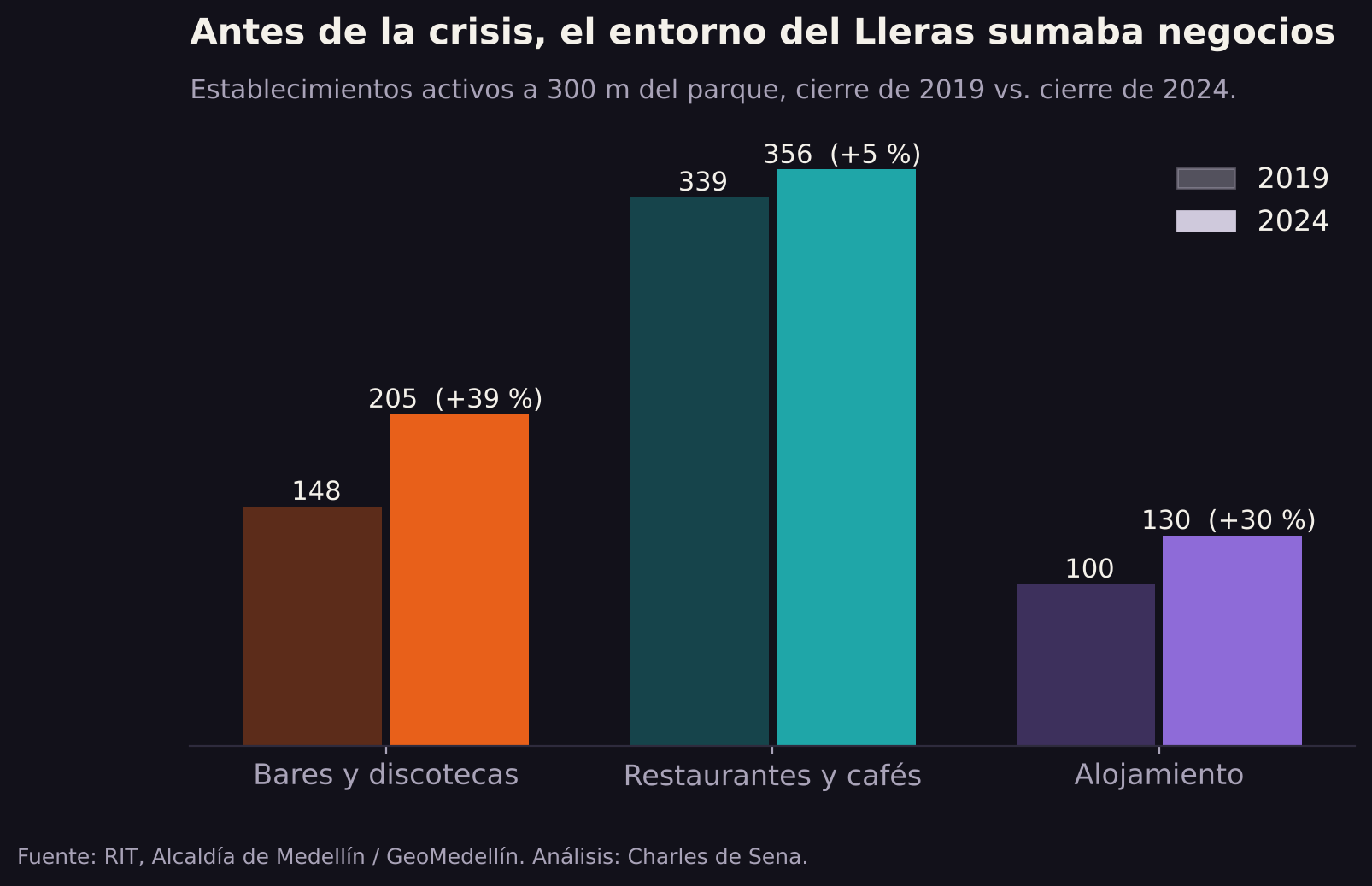
Within 300 meters of the park there were 2,565 active businesses at the end of 2024. Between 2019 and 2024, bars and nightclubs went from 148 to 205 (+39%), lodging from 100 to 130 (+30%), and restaurants and cafés from 339 to 356 (+5%).
Compared with the rest of the city, the pattern is clear. Taking 2019 as a base of 100, the area around Lleras reached 114 in 2023, practically the same as the rest of Medellín (115). The rest of El Poblado grew faster, reaching 130.
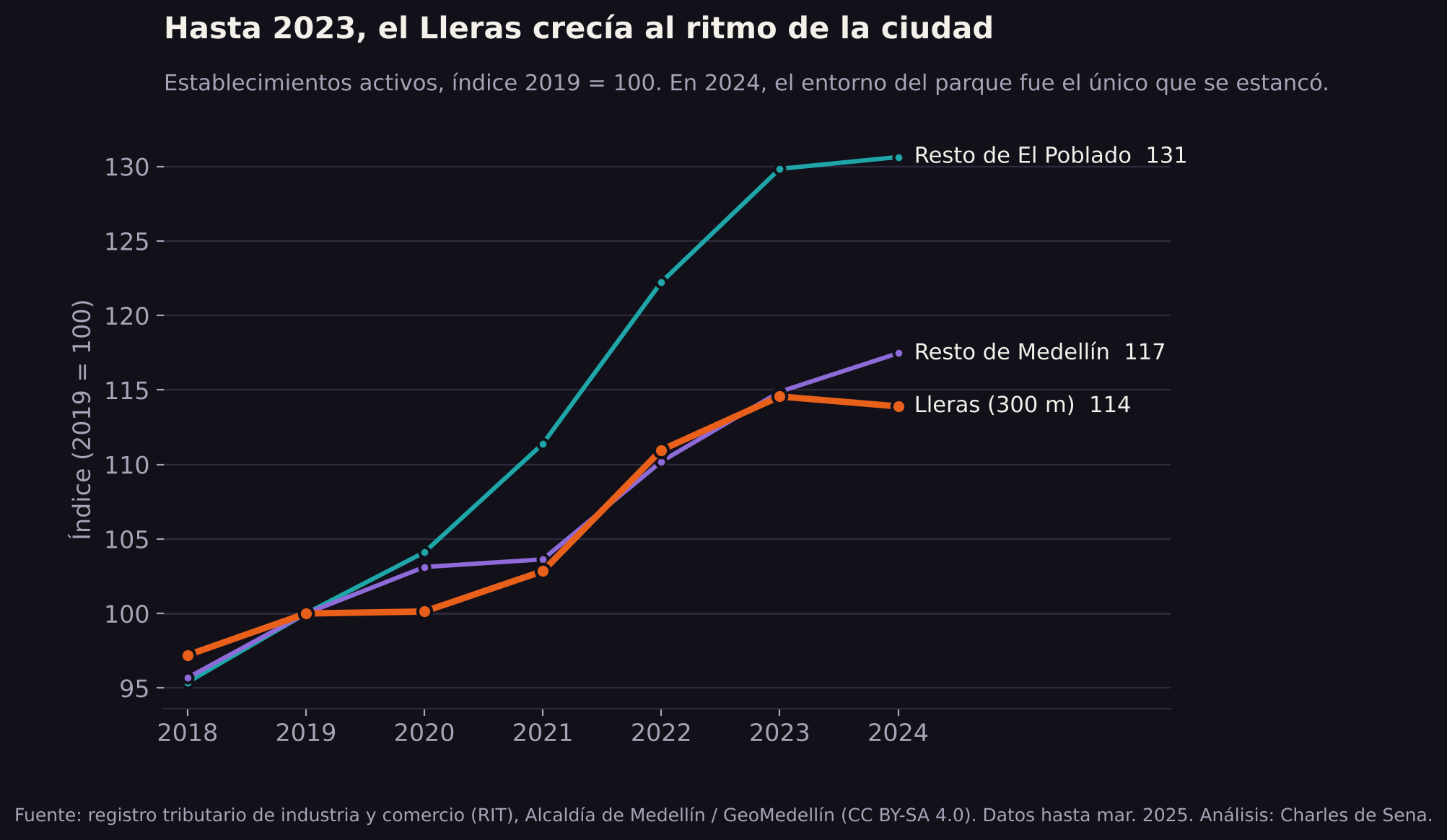
The only different signal shows up in 2024: the area around the park stalled (−0.6% compared with 2023), while the rest of El Poblado and the city kept growing. It’s a small signal and has to be read carefully: businesses are registered with a lag, which is why 2024 openings look low across the whole city, not just in Lleras. With current data, that stall can’t be attributed to any single cause.
What can be said is this: until 2023, Lleras was an expanding economy, not a neighborhood in decline. What’s at stake, then, is not a dying sector but one of the city’s engines of tourism and nighttime employment.
The map shows 1,243 bars, restaurants and lodging businesses active at the end of 2024, just a few blocks from the park. Turn on the robbery layer (“Ver hurtos a personas”) to see how they overlap with the 2022 security data. Open the map in full screen.
Lleras Was Already El Poblado’s Most Critical Spot
The city’s security data (MEData, from the Security and Coexistence Information System) shows another side of the same place. In 2022, the last year with geolocated robbery data, there were 944 robberies of people within 300 meters of the park. That area is 2% of Comuna 14 (El Poblado), but it accounted for nearly 20% of the district’s robberies.
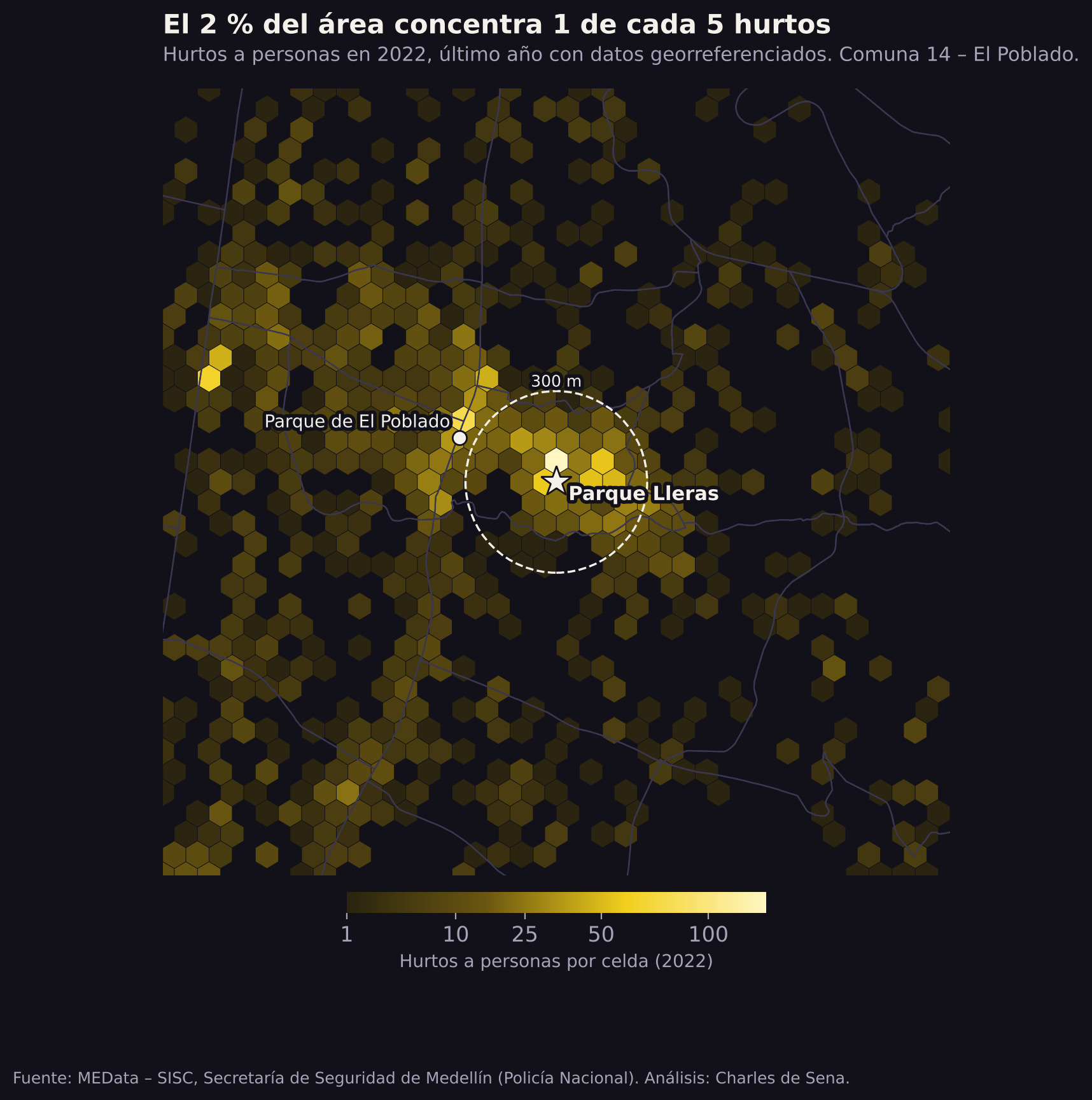
The pattern is typical of a nightlife economy: 57% of those robberies happened between 10 p.m. and 5 a.m., and 64% between Friday and Sunday. About one in twenty cases involved scopolamine.
This matters for two reasons. First, the mayor’s office’s concern was not unfounded: Lleras was already the district’s main hotspot for robberies of people before any decree. Second, the map shows a second hotspot next to Parque de El Poblado, exactly where displacement was expected to go. Without more recent data, it’s impossible to know whether that hotspot grew.
What Happened Next: a Timeline with a Gap
The interventions piled up in a short time:
- May 2023. The park is fenced off. Business owners report sales drops of around 40%.
- April 2024. Decrees suspend, for six months, the demand for sexual services in public spaces in Lleras, Provenza, Calle 10 and Parque de El Poblado, and set closing time at 1 a.m.
- July 2025. Police operations under Decree 0265 of 2025.
- January 2026. Surprise large-scale operation with around 300 officials.
- October 2026. Asobares reports that 7 of its 24 members remain. Fenalco, the national merchants’ federation, says nighttime labor costs rose more than 30%. A tutela (constitutional rights claim) is filed against the proposal to ban street sex work.
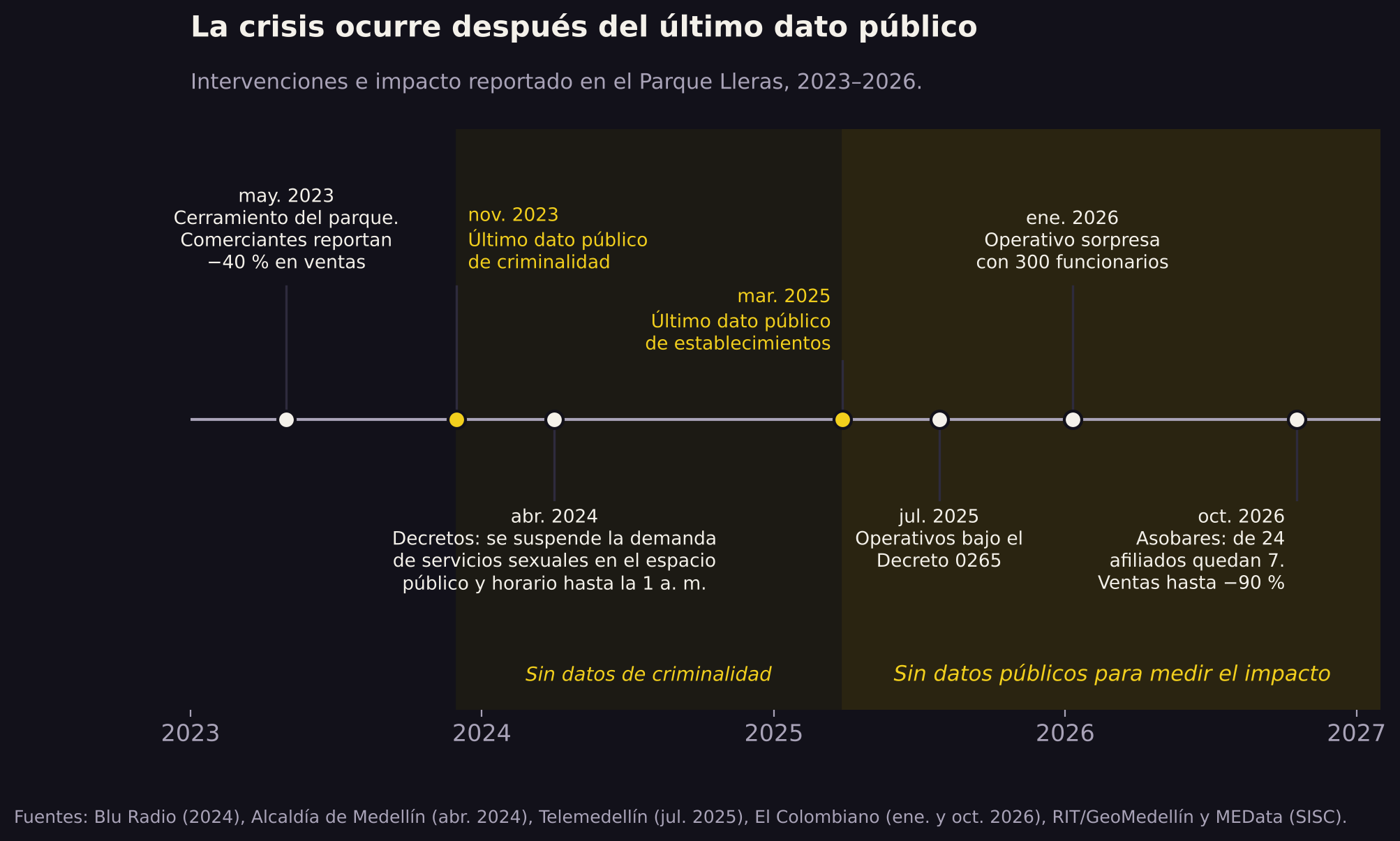
The yellow dots on the chart are the core of this article. Public crime data ends in November 2023, and from that year on it no longer includes coordinates, so the last possible map is from 2022. The business registry ends on March 28, 2025. In other words: the 2024 decrees were applied without open security data, and everything after March 2025 (the 2025 decree, the large-scale operations, the closures reported by the industry) is happening with no open data at all.
This means that today, nobody outside the administration can answer basic questions with public evidence: how many businesses actually closed, how many jobs were lost, whether the activity moved to other streets, or whether crime fell in the park and rose somewhere else.
The Mayor’s Office’s Arguments Deserve to Be Taken Seriously
It would be dishonest to present this as a story of business owners versus a capricious government. The sexual exploitation of children and adolescents in El Poblado is real and documented. According to the mayor, a network known as “El Mexicano” operated in seven venues linked to human trafficking, and some of the businesses that now appear as “closed” are precisely those.
It’s also relevant that the 2024 decree targeted demand, meaning the buyer, not the person offering the service. In public policy terms, that approach is consistent with what many anti-trafficking organizations recommend.
The problem isn’t that the state is acting. The problem is that a policy that isn’t measured can’t be corrected.
The Risk Nobody Is Measuring: Displacement
In 2023, a sector leader estimated that around a thousand people were doing sex work in the area (about 600 Colombians and 400 Venezuelans) and warned that they would move toward Parque de El Poblado and Calle 10. It’s not an official figure, but it describes an effect well known in urban studies: when you put pressure on one spot without addressing the causes, the activity moves.
If that happens, the result can be worse than the original problem:
- The most vulnerable people end up on streets with less lighting, less institutional presence and more risk.
- Exploitation networks adapt faster than regulation.
- Receiving neighborhoods absorb the problem with no resources and no warning.
Colombia’s Constitutional Court has already set limits in this area. In ruling T-629 of 2010, it recognized that sex work freely carried out by adults is an economic activity and that those who do it have labor rights. In ruling T-594 of 2016, it protected sex workers from police actions in public spaces. Fighting exploitation and respecting those rights are not opposing goals; confusing them is what produces bad policy.
Three Questions to Think About
1. How will we know whether it worked? Medellín has one of the best open data infrastructures in the country, and its security datasets used to be updated monthly. Publishing the business registry, crime by neighborhood and the results of police operations on a regular basis again would allow academia, the press and business associations to evaluate the policy from the same evidence.
2. Where did the problem go? A place-based policy should also measure neighboring areas. If indicators improve in Lleras and get worse 800 meters away, there was no solution, only a relocation.
3. What happens to the legal economy? Distrito Palermo, the area’s urban renewal project, is estimated at around one trillion Colombian pesos (roughly US$250 million). Before 2025, the area around the park was growing at the same pace as the city. Recovering that economy without going back to tolerating exploitation requires a plan with targets, not just police operations.
Conclusion
Lleras doesn’t need to choose between security and the economy, or between protecting victims and respecting adults who work. It needs something simpler and harder: decisions that can be verified.
Today, the public debate is fed by isolated figures: 90% from a trade association, 430 arrests from the mayor’s office, a thousand people estimated by a sector leader. None of them is wrong in itself, but none shows the full picture. As long as security data stops in 2023 and business data in March 2025, each side will keep being right about its own piece of the story, and the city will keep not knowing whether it solved the problem or just moved it down the street.
A policy that doesn’t publish its data asks for trust instead of offering evidence. Medellín, which built one of the best open data platforms in Colombia, can do better: updating MEData and the business registry would be the first step for the city to stop arguing in the dark.
Methodology
- Source: the industry and commerce tax registry (RIT) published by the City of Medellín on GeoMedellín (CC BY-SA 4.0 license). Data available up to March 28, 2025.
- Active business: a record with a start date and no cancellation date as of December 31 of each year. 4,559 records with no dates were excluded.
- “Lleras (300 m)” area: businesses within 300 meters of the approximate center of the park. “Rest of El Poblado” and “Rest of Medellín” exclude that area.
- Types: classified by economic activity (bars and nightclubs; restaurants and cafés; lodging).
- Limitation: the registry measures tax registration, not actual operation. A venue can close without canceling its registration, and recent openings appear with a lag.
- Robberies: the “Hurto a persona” (robbery of a person) dataset from MEData (SISC, Secretariat of Security and Coexistence, with data from the National Police), CC BY-SA 4.0 license. Records run to November 30, 2023; the 2023 records have no coordinates and use a different neighborhood coding, which is why the spatial analysis uses 2022. Comuna 14 boundaries from the POT (land-use plan) neighborhood layer.
- Other sources: El Colombiano (January and October 2026), City of Medellín (April 2024), Blu Radio (2024), Telemedellín (July 2025), Constitutional Court records.
The charts and maps may be reproduced by media outlets with credit: Analysis: Charles de Sena using open data from the City of Medellín.
Interested in this kind of analysis for your company or newsroom? I also built the Medellín Commercial Opportunity Map with the same data.