Before opening a café, a hair salon or a corner store, almost everyone asks the same question: how long will it last? Almost no one can answer it with data.
The City of Medellín can. Its business registry records the date each business registered and, when it applies, the date it cancelled its registration. I analyzed the 168,000 urban businesses opened between 2012 and 2019, the years with enough follow-up time to know what happened to each one.
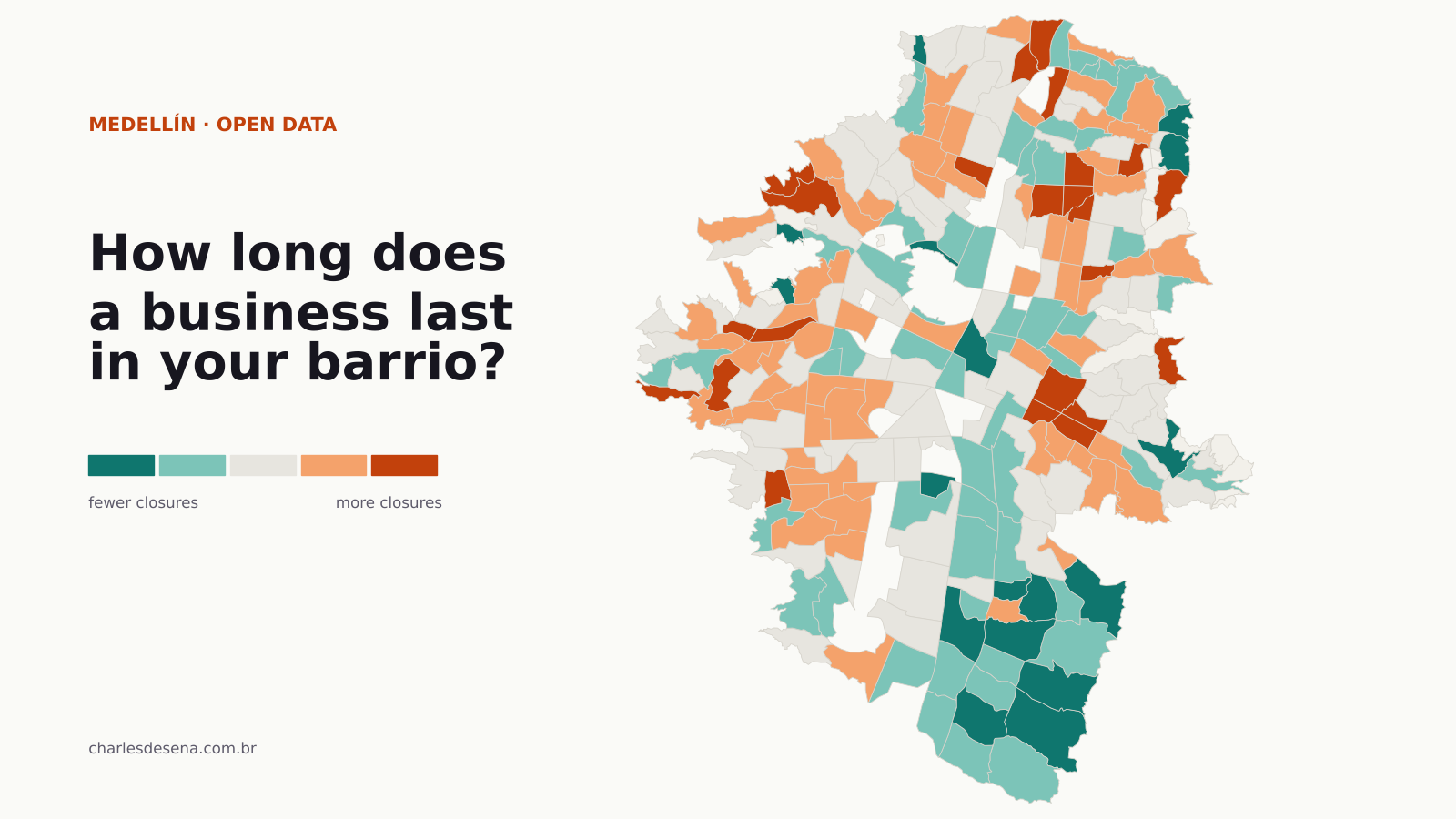
The map: choose your type of business
Pick a type of business and see how it does in each neighborhood (barrio) compared with the city average. Green means fewer closures; orange means more. Hover over a barrio to see the share that closed within 1, 3 and 5 years.
What the data shows
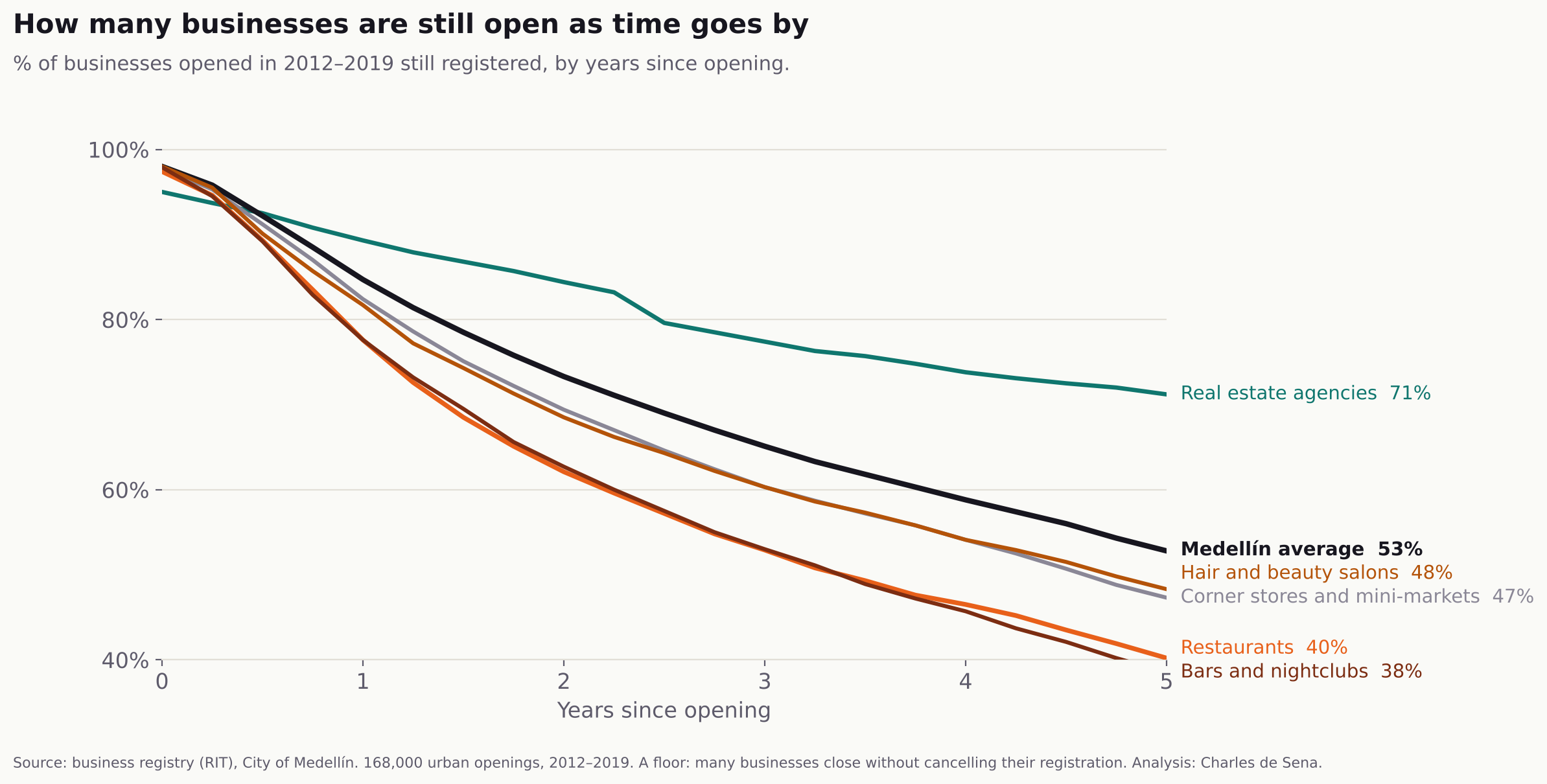
1. One in three businesses cancels within 3 years. Of the businesses opened between 2012 and 2019, 15% cancelled their registration in the first year, 35% within 3 years and 47% within 5. In other words, after 5 years, only about half are still registered.
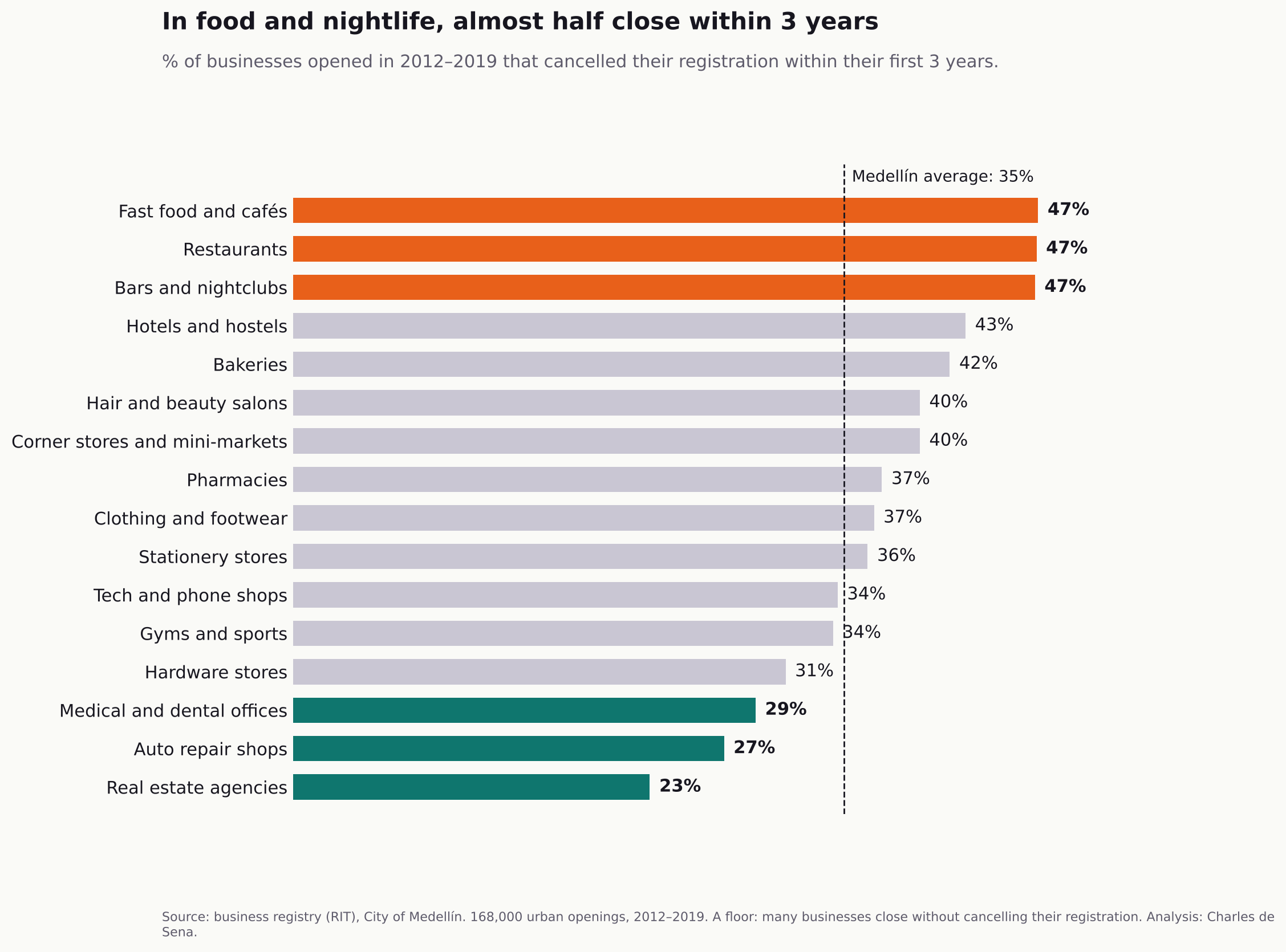
2. In food and nightlife, almost half close within 3 years. Restaurants, fast-food places and bars all sit at 47%. At the other end are real estate agencies (23%), auto repair shops (27%) and medical and dental offices (29%): businesses with repeat customers, contracts or higher barriers to entry.
3. The early years are the hardest. The curve drops fastest at the start and then levels off. After 5 years, 71% of real estate agencies, 48% of hair and beauty salons, 47% of corner stores, 40% of restaurants and 38% of bars are still registered.
4. The block matters more than the district. Between the city’s comunas (its large administrative districts), the gap is moderate: the share closing within 3 years ranges from 31% in El Poblado to 38% in La América and Aranjuez. Between barrios the gap is much wider, from 22% in Tenche (Guayabal) to 46% in Los Alpes (Belén). And within a single comuna it can be huge: in El Poblado, 26% of the restaurants opened in Los Naranjos closed within 3 years; in Castropol, 71% did.
5. The competitor next door isn’t what matters most. At first glance, restaurants that open surrounded by other restaurants close more often: 42% with about 6 competitors within 300 meters, 50% with more than 100. But that gap disappears when you compare businesses opened in the same comuna and the same year. The same holds for corner stores, salons, bars, clothing stores and pharmacies. What matters is the area and the type of business, not having a competitor next door. In clothing, for example, shops with more than 2,000 competitors nearby, as in El Hueco, last as long as the average.
What to do with this
If you’re opening a business in Medellín:
- Plan your cash for more than a year. If half the businesses in your sector close within 5 years, your plan can’t depend on everything going right in the first few months.
- Look at your barrio and your sector together. The same type of business does very differently a few blocks apart. The map is a starting point, not a verdict.
- Don’t fear competition; fear having no customers. Areas full of similar businesses work when there’s foot traffic. What you need to validate is demand: how many people look for what you sell in that area.
- Test before you invest everything. A small Google or Meta campaign targeted by neighborhood can show within weeks whether there’s demand, before you sign a multi-year lease.
Limits
- It’s a floor. Many businesses close without cancelling their registration, so the real share that closes is higher. For the same reason, recent openings appear to close less: of the businesses opened in 2021, fewer than 20% show as closed after 3 years, compared with 34% of those opened in 2018. They don’t last longer; closures are recorded years late. That’s why the analysis uses only 2012–2019.
- A registration isn’t a storefront. A change of owner, name or address can show up as one closure and one new opening.
- Administrative clean-ups. The city cancels inactive registrations in bulk on certain dates (for example, December 31, 2017). They carry little weight in a business’s first 3 years, but they exist.
- Barrios with little data. The map only shows barrios with at least 25 openings of the chosen type, and adjusts them toward the average when there are few. The “most and fewest closures” lists use barrios with at least 50.
Methodology
- Source: the City of Medellín’s business registry (RIT), published on GeoMedellín (CC BY-SA 4.0 license), with data through March 28, 2025.
- Universe: 168,572 businesses with a start date between 2012 and 2019, located in comunas 1 to 16. All have at least 5 years of follow-up.
- Closure: the date the registration was cancelled. “Closes within 3 years” = cancelled within 3 years of its start date.
- Types of business: grouped by ISIC code (for example, restaurants = 5611; fast food and cafés = 5612, 5613 and 5619; bars = 5630; corner stores and mini-markets = 4711, 4719 and 4721–4729).
- Map: each barrio’s difference from the city average for the same type of business, with a statistical adjustment toward the average in barrios with few openings.
- Competition: businesses of the same type active within 300 meters on the opening date. Effect estimated with a logistic regression that controls for comuna and year of opening.
The charts and the map may be reproduced by media outlets with credit: Analysis: Charles de Sena using open data from the City of Medellín.
Opening a business, or want yours to last longer? I can help you validate demand in your area before you invest, and bring in customers with measurable campaigns. See the Business Opportunity Map or message me on WhatsApp.