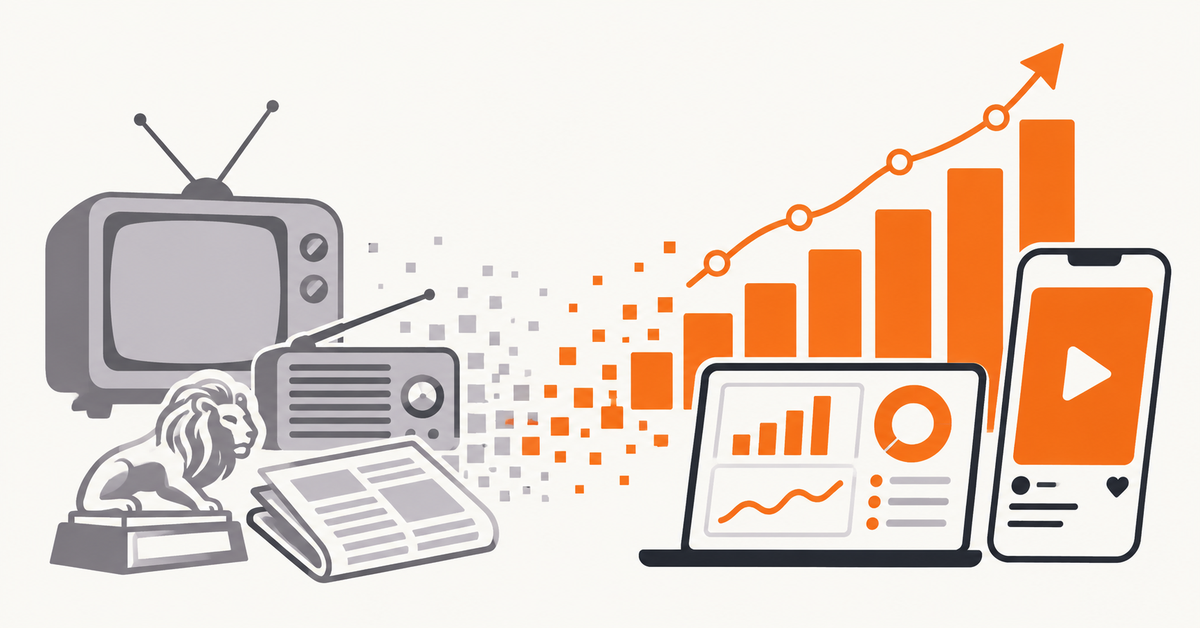
When I started in media, the job had a familiar rhythm. TV, radio, newspapers and magazines had been around for decades, the metrics were few and stable, and a good plan could put most of the budget into a single outlet. Between 2019 and 2025, that world moved, and I moved with it.
The story below uses data from Brazil, where I worked through those years. It is the world’s sixth-largest ad market, and the same forces that reshaped Madison Avenue reshaped it too: short video, creators, performance pressure, holding-company mergers. The numbers are in Brazilian reais (R$); for scale, the biggest broadcaster’s revenue works out to about US$ 3.3 billion.
Figures from Cenp-Meios, the panel that adds up media buying by Brazil’s largest agencies, show the size of the shift. In 2019, broadcast TV took 52.8% of the money and internet 21.2%. By 2025, internet had 40.6% and broadcast TV 33.6%. Adjusted for inflation, broadcast TV lost a quarter of its value and internet more than doubled.
One caveat: Cenp-Meios is not the whole market. It adds up media buying by participating agencies, about half of what flows through agencies, excludes direct buys on the platforms, and the roster changes every year: 226 agencies in 2019, 330 in 2025. So the split between media is the safest reading, and comparing total volumes across years calls for caution.
The comfortable world of offline media
Until the pandemic, offline media was familiar ground. In 2019, broadcast and pay TV together took almost 60% of agency media buying. Budgets were large and concentrated, negotiations involved a handful of outlets, and one year’s plan looked a lot like the year before.
In that market, what counted was the work itself. Cannes was an ego trophy, and the Lion on the wall brought in clients. The glamour of the campaign weighed more than proof of results, partly because data was hard to produce and hard to deliver.
Agency structures were also barely exposed to technological change. People in the business had learned to work with the same media for decades, and nobody had to reinvent themselves every year.
The pandemic changed habits, and the money followed
After the pandemic, TikTok arrived in force. Short video and influencers took a share nobody in the market had planned for, and budgets followed the audience’s attention.
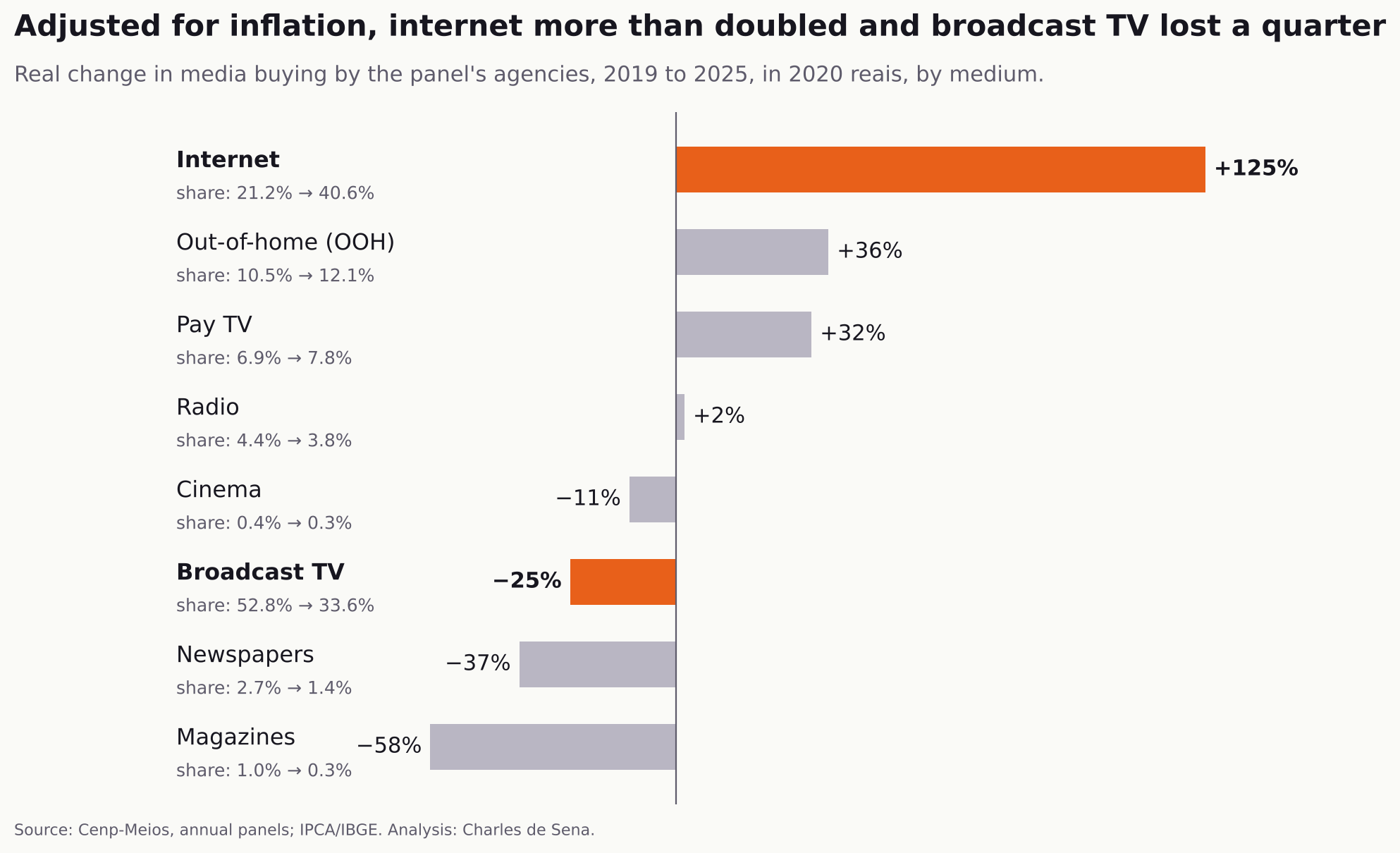
Within the panel, internet went from R$ 3.7 billion in 2019 to R$ 11.7 billion in 2025 and overtook broadcast TV in 2024. Social media buying through agencies alone jumped from R$ 0.9 billion to R$ 2.9 billion. Broadcast TV received almost the same nominal amount in 2025 as in 2019, which, after inflation, is a 25% loss. Newspapers and magazines lost more than a third and more than half of their real value.
And that is only the slice that goes through agencies. Creator spending does not even show up in IAB’s measurements, and direct buys on the platforms sit outside the panel.
It grew in reais; in purchasing power, much less
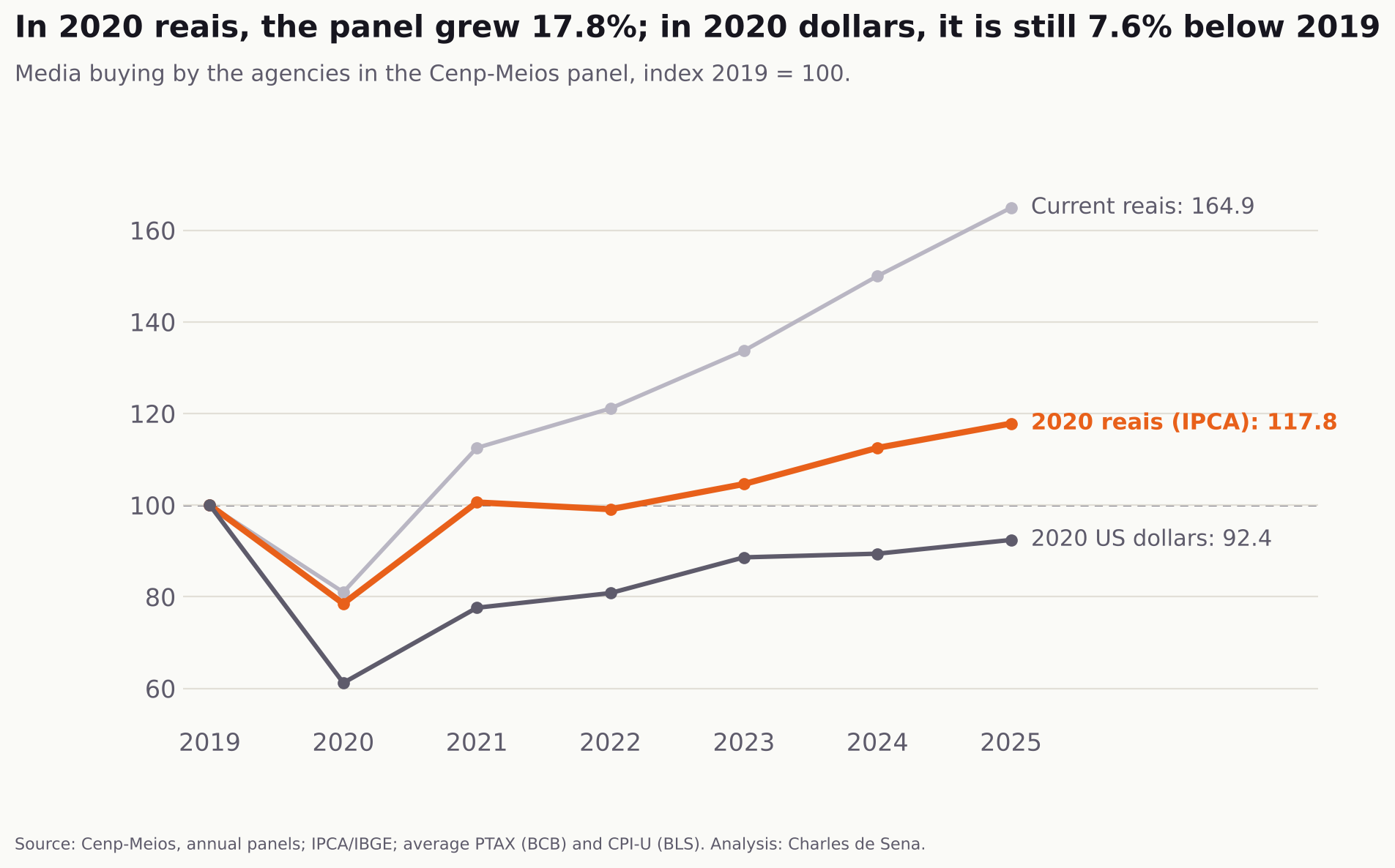
Across all media, buying by the panel’s agencies rose 64.9% in reais from 2019 to 2025. After inflation, that is 17.8%, a little over 2.7% a year. In 2020 dollars, it is still 7.6% below 2019. Because the panel’s composition changes every year, these figures show the order of magnitude, not an exact series.
In other words: the pie barely grew in purchasing power. What changed was how it is sliced. For agencies, that means fighting over a similar budget across more media, more formats and more demands for data. For global holding companies, which report in dollars, Brazil in 2025 is worth less than Brazil in 2019.
Agencies had to reinvent themselves
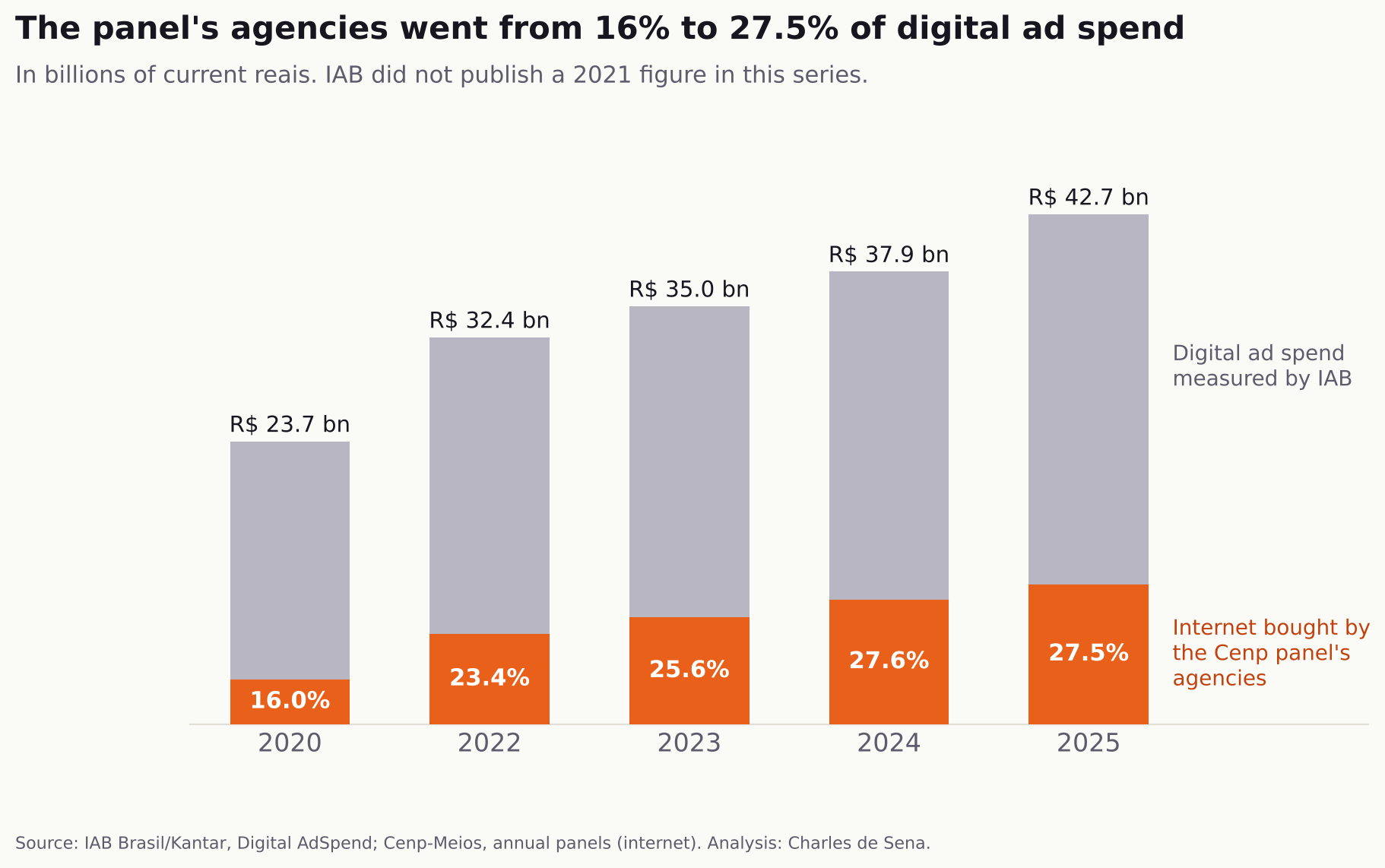
The big groups started paying close attention to a market they had ignored before the pandemic, or treated as small money of little relevance. Internet bought by the panel’s agencies went from 16% to 27.5% of all digital ad spend measured by IAB, which reached R$ 42.7 billion in 2025 (IAB Brasil). Agencies moved into digital, not out of it.
Those who underestimated digital fell behind, and I watched many agencies close because they were not ready for the change. The media-buying rankings show the churn at the top and the consolidation: with Omnicom’s acquisition of IPG, completed in November 2025, four of the eight largest buyers of 2025 ended up under the same owner (Meio & Mensagem). At the other end, independents such as Galeria and Artplan held their place among the top ten.
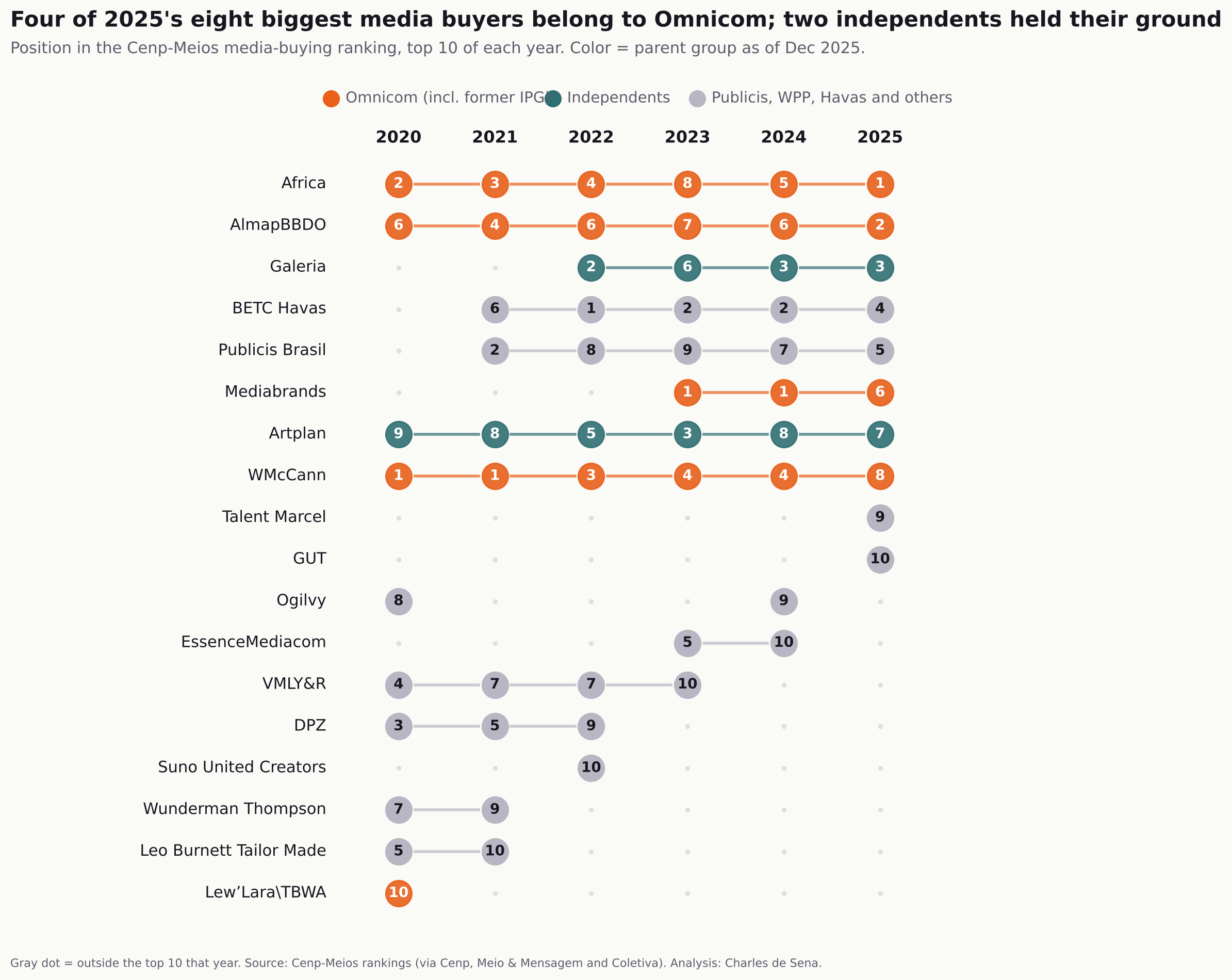
Four different agencies led in six years: WMcCann in 2020 and 2021, BETC Havas in 2022, Mediabrands in 2023 and 2024, Africa in 2025. Of the top ten in 2020, only four are still there: WMcCann, Africa, AlmapBBDO and Artplan. Part of the turnover is holding-company reshuffling, not lost clients: VMLY&R and Wunderman Thompson became VML, and MullenLowe was folded into Mediabrands.
The shift came at a cost. Deloitte’s study for ABAP, the Brazilian agencies’ association, puts the median net margin at 14.6% in 2010 and 5.66% in 2023, with expenses growing faster than revenue from 2020 to 2023 (ABAP/Deloitte). The sample is small, 23 agencies, and the study was commissioned by the agencies’ own association, but the direction matches what the market shows.
TV felt it too
For the networks, the change shows up in the financial statements. Globo, Brazil’s largest media group, closed 2025 with net revenue of R$ 18.3 billion (about US$ 3.3 billion), up 11.4% from R$ 16.4 billion in 2024. Much of that increase comes from Eletromidia, an out-of-home company Globo bought in December 2024 that was only consolidated for a full year in 2025. At the parent company, which does not yet include Eletromidia, revenue grew 3.1%, below inflation. In other words, the country’s biggest media group grew in 2025 largely by buying a medium that is gaining ground.
Beyond Globo, the picture is harsher. Band billed R$ 733 million in 2025, essentially flat on 2024, with a R$ 283 million loss and negative equity of R$ 1.8 billion (Central de Balanços). Record, in its last published statements, for 2022, had parent-company revenue essentially flat against 2019 (R$ 1.95 billion to R$ 2.01 billion), well below inflation over the period. SBT does not publish financial statements; available estimates put it near R$ 1.3 billion in 2025.
From craft to efficiency, and now AI
Today everything is data, performance and funnel. Much of the craft was lost, because what matters is efficiency. That is not in any panel: it is what I saw happen at the planning table. The closest number is agency margins, which ABAP/Deloitte saw fall from 14.6% to 5.66% in a little over a decade. Efficiency became the client’s yardstick and, at the same time, squeezed the business of those who deliver.
The market has not found its balance yet, and the numbers show it is still swinging. Pay TV, which until 2024 received less real money than in 2019, jumped 47% in 2025 alone, with no clear explanation. Out-of-home became the panel’s third-largest medium, at 12.1% in 2025.
Just when things seemed to be settling, artificial intelligence arrived and moved everything again: production, buying, measurement and agency compensation itself. There is no public data in Brazil yet that measures that effect, which is exactly why it deserves attention.
What I learned
This change reshaped my work. When I started running campaigns for a telecom company, my data was the sales team’s feedback: I knew whether a campaign sold because the department taking the orders told me. To find out which bus route had the most impact or which billboard worked, the team asked customers where they had seen or heard the ad. The rest was estimation, because not every client could afford a syndicated survey.
Today a client’s history tells me more than any purchased survey: where the call came from, which creative generated the most revenue, how long the sales team took to respond, which channel the customer prefers (WhatsApp, phone, email or social), where they engage most, where they complain and what about. A brand-lift study adds to it, but first-party data is the foundation. That data is gold: structuring it shows me where I went wrong and what to do in the next cycle. There are no mistakes, only lessons; the money spent always turns into something I can use.
That is when I had to leave a comfortable market and specialize: data-driven digital media, with measurement, analysis and continuous optimization. My telecom client now knows exactly which channel converts best, who complains and what they say about the product. A real-estate developer knows which creative converts, which professions buy, which income bracket and investor profile pay off, and which sales agent makes the difference. A well-built CRM became a revenue source, and the data team became the heart of the business, not a spreadsheet factory to ignore.
What I take from this for anyone who advertises:
- Look at the numbers in real terms. A budget that grows in nominal currency may be shrinking in purchasing power.
- Revisit the media mix. It changed a lot in six years; the 2019 plan does not work for 2025.
- Demand data from your agency without giving up creativity. Efficiency without an idea is just a media auction.
About the numbers
- Cenp-Meios panel: amounts billed by media outlets on purchases by participating agencies, by medium, in reais and dollars (annual panels). The panel covers about half of agency buying, excludes direct buys on the platforms and grew from 226 to 330 agencies over the period.
- Inflation and exchange rates: 2020 reais using IBGE’s IPCA (annual average of the index); 2020 dollars using the Brazilian central bank’s average PTAX rate and the US CPI-U.
- Networks: published financial statements for Globo and Band (2025) and Record (through 2022, the latest available); SBT from Teleco and EMIS, with 2024 and 2025 estimated.
- Agencies: IAB Brasil and Kantar (Digital AdSpend 2025), Cenp agency rankings and the ABAP/Deloitte study.
Every figure has its source, date and reliability grade logged in an audit base with 82 sources.
Media outlets may reproduce the charts with credit: Analysis: Charles de Sena.
Want this kind of data analysis for your market or business? Message me on WhatsApp.