It’s Black Friday. For anyone selling online, the day started at midnight, and a big share of it is being decided right now. I pulled together what the main studies say about this year’s edition in Brazil, Latin America’s largest e-commerce market, what it means in practice for anyone running ads, a store or customer service, and an example of a brand that came in prepared. Most of the lessons apply just as well to a U.S. retailer.
How big the weekend is
The most widely cited forecast comes from Confi, through its Neotrust platform, with E-Commerce Brasil: R$ 13.3 billion in online sales between November 26 and 29, up 20.7% from R$ 11.03 billion over the same four days in 2025, with 69.4 million products sold (+15.4%). Home appliances should lead, with R$ 2.12 billion (Meio & Mensagem, Central do Varejo).
Other estimates measure different things and shouldn’t be compared directly:
- Abiacom: R$ 16.6 billion for Black Friday week, up 24.4%, with 21.7 million orders (Gironews).
- Stefanini Marketing (W3haus, Gauge and Ecglobal): R$ 14.5 billion, up 8.4% (Times Brasil).
- CNC, Brazil’s retail federation: R$ 11.52 billion across all retail, in-store and online, up just 1.8%, though still the highest since 2014 (IstoÉ Dinheiro).
The common thread: online is growing much faster than retail as a whole.
More orders, smaller baskets
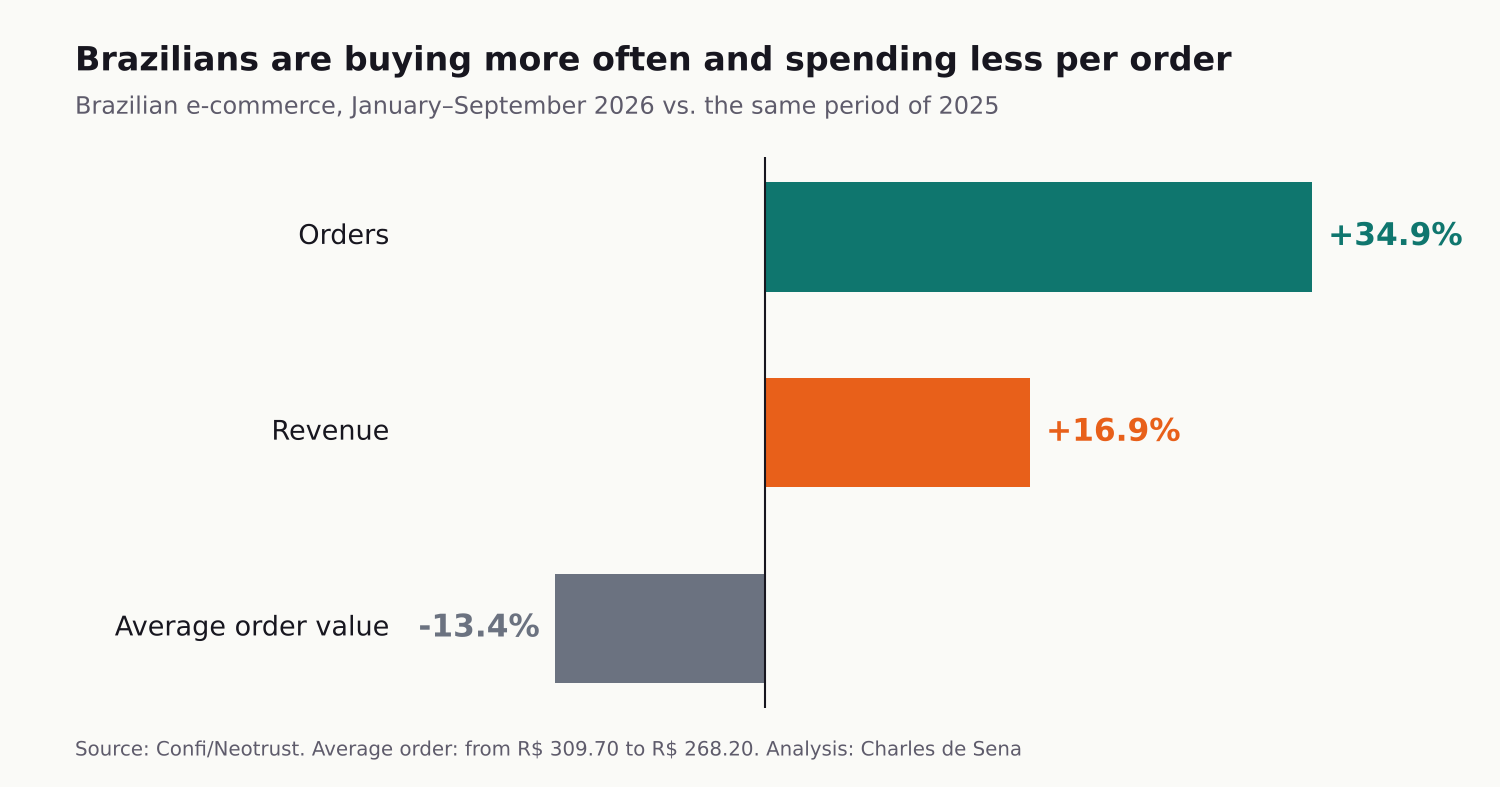
The number that best explains this Black Friday comes from the year so far. From January to September, Brazilian e-commerce brought in R$ 322.6 billion (+16.9%), but orders jumped 34.9% to 1.2 billion, and average order value fell 13.4%, from R$ 309.70 to R$ 268.20 (Central do Varejo).
The reason is credit. The CNC points out that personal loan rates are running at 61.7% a year and that 29.6% of households are behind on bills (brapi/CNC). Even so, more than 66% of likely buyers plan to pay in installments (Serasa Experian, via Mercado & Consumo). For sellers, the discount alone doesn’t close the sale. The monthly installment, the discount for paying by Pix (Brazil’s instant payment system), shipping cost and delivery time all weigh in.
Fewer shoppers plan to buy, and that’s no reason to panic
Purchase intent for the day dropped to 62%, from 78% in 2025, according to Fiserv and Opinion Box (Central do Varejo). Google’s survey shows a similar shift, from 61% to about 50% (Meio & Mensagem).
That fits with a growth forecast because buying has spread out. According to LWSA, 54% of shoppers plan to buy throughout November as deals show up, and 50% start researching more than a month ahead (Mercado & Consumo). In 2025, the four Black Friday days made up 23.5% of November’s e-commerce revenue (Central do Varejo). Friday matters less on its own; the whole month matters more.
Friday gets decided early
In 2025, Brazilian e-commerce brought in R$ 4.76 billion on Black Friday itself, and 35.5% of that came in the first 12 hours (Confi Neotrust). If your store only ramps up ads and support in the afternoon, it has already missed a third of the day. There’s still time to fix that for Saturday, Sunday and Cyber Monday on the 30th.
Trust now drives conversion
Scams are no longer just the shopper’s problem. In a Serasa Experian survey, 86% say they’ve walked away from a deal at some point for fear of fraud. Their biggest worries are fake websites (53%), Pix scams (42%) and fake ads on social media (32%). During Black Friday week in 2025, the fake ads the company detected rose 147% (Serasa Experian, Mercado & Consumo).
In practice, visible company details, official channels, a clear return policy and real reviews on the product page sell as much as the discount does. Uptime counts too: 25% of shoppers would give up on a good deal if the site kept failing (Startupi/LWSA).
AI has joined the price check
According to Stefanini Marketing, 86% of shoppers plan to use AI for their November purchases, mostly to compare prices (49%), check whether a discount is real (47%) and see whether a store can be trusted (42%) (Investidor10). In an HSR study of real searches on ChatGPT and Gemini, Magalu, Mercado Libre and Amazon were the retailers recommended most often (Meio & Mensagem).
One detail matters for sellers: when a question mentions “Black Friday,” warnings about price history and suspicious discounts go from 15% to 34% of ChatGPT’s answers (Central do Varejo). AI now calls out inflated discounts too. A price with a consistent history, complete product specs and a solid reputation are what get a store recommended in those answers.
What to do through Cyber Monday
- Watch conversion, not traffic. Find the products with lots of visits and few sales, and check their price, shipping, installments and checkout first.
- Shift budget to what’s selling. A strong campaign that runs out of budget in the afternoon leaves money on the table; a weak one with budget to spare burns margin.
- Don’t advertise what’s about to sell out. Pull low-stock items from your ads and push alternatives.
- Bring back people who already showed interest. Abandoned carts, product viewers and email openers convert more cheaply than new audiences.
- Plan the weekend and Monday. Decide now what changes on Saturday, Sunday and Cyber Monday instead of improvising.
- Monitor the site like it’s a channel. A mobile checkout bug costs more than a high CPC.
A brand that planned ahead
I work with agencies and clients to bring data intelligence into their advertising and store operations. One of those projects, together with Radar do Marketing, is Janome, the sewing machine brand, in Brazil. The credit here goes to the client: Janome itself decided to treat Black Friday as Black November, a full month rather than a single day.
The plan came with clear targets and a budget split between remarketing, cart recovery and new campaigns on Google, Meta and TikTok. The catalog went live on TikTok Shop, and the remarketing audiences were built well in advance. Throughout the month, the team checks a daily dashboard that compares the plan with what GA4 is recording, and an alert system flags any metric that breaks pattern, instead of waiting for next week’s report.
The result: on the busiest day of the year, nobody is flying blind, and the planning is already paying off. I don’t publish client numbers, but the lesson holds for stores of any size: the ones who planned the month are fine-tuning the day; the ones who didn’t are putting out fires.
Happy Black Friday
Black Friday 2026 is less about who spends the most on ads and more a test of efficiency: an offer that fits the shopper’s budget, a store they trust, and decisions made with data in hand. Wishing a great Black Friday to every merchant out there, from marketplace sellers to the person behind the counter. May the sales come with margin.
Neotrust publishes its first results for the four days on Monday, and I’ll update this post with the actual numbers.
Want a second look at your ad accounts, or a tracking dashboard for your next big sales event? Message me on WhatsApp.