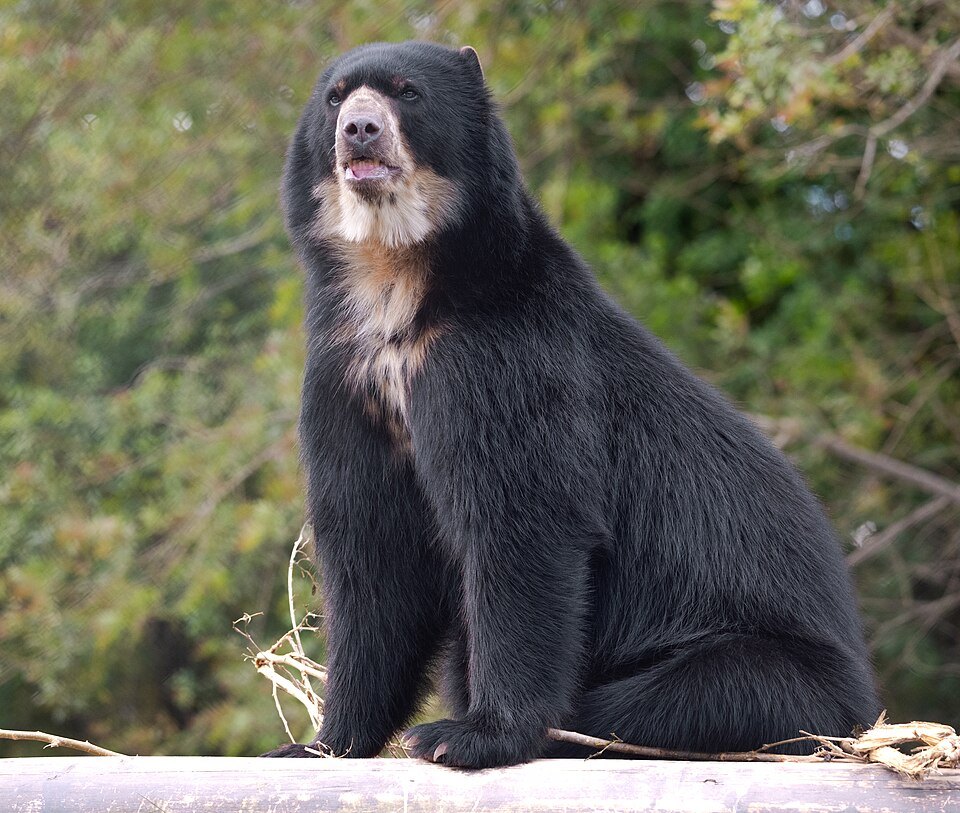
The Andean bear, also called the spectacled bear, is the only bear species in South America. It lives along the Andes, from Venezuela to Bolivia, and the International Union for Conservation of Nature (IUCN) lists it as Vulnerable, with a population that keeps declining.
But if you ask how many Andean bears are left in Colombia, the answer depends on who you ask. In 2016, the then environment minister spoke of about 700. In 2017, WWF estimated around 8,000. And in 2026, Colombia’s National Natural Parks service estimated between 4,100 and 10,700.
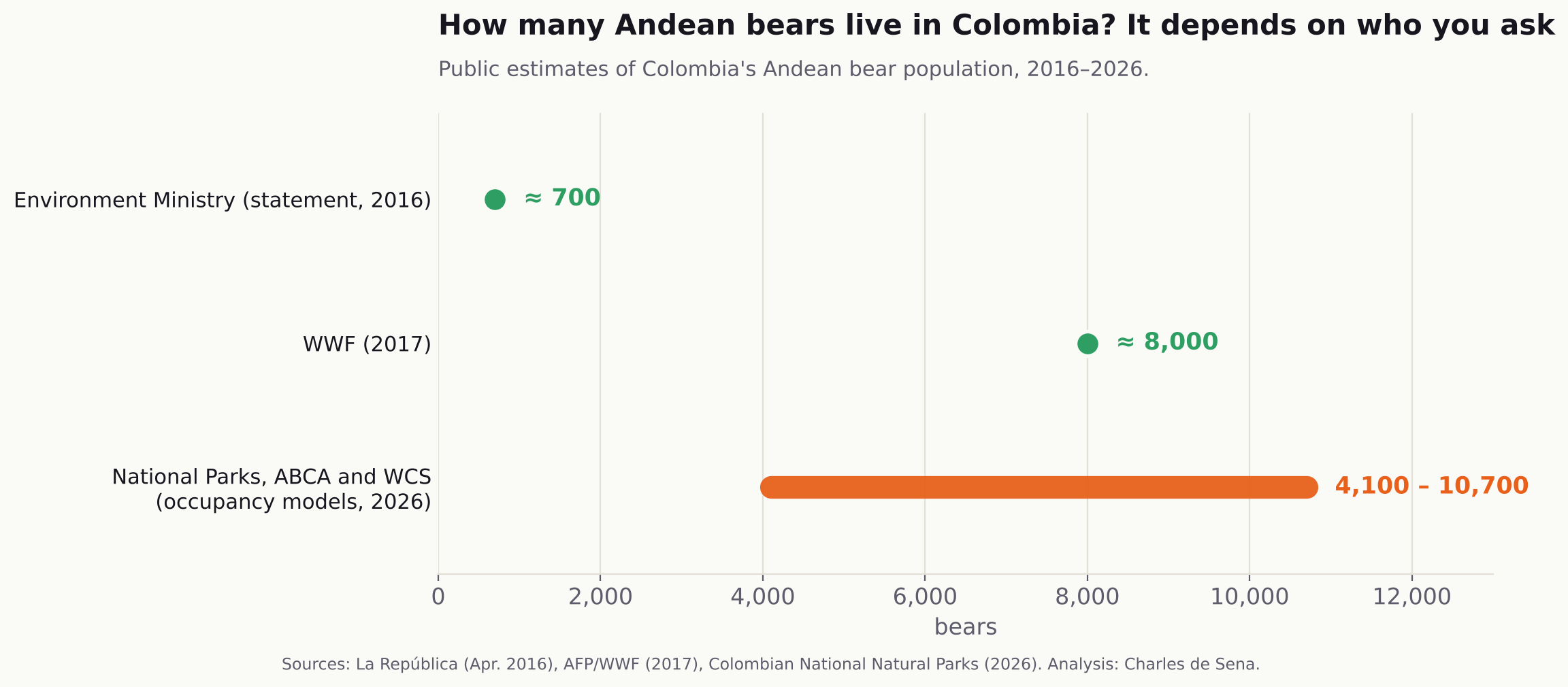
That gap doesn’t mean anyone is lying. It means something more uncomfortable: counting bears in the mountains is very hard, and for years the country made decisions about a species whose population it didn’t know. This article brings together what is known, using open data and scientific studies, and what still isn’t.
Where South America’s Only Bear Lives
The Andean bear occupies a long, narrow strip: more than 4,600 kilometers long and only 200 to 650 kilometers wide, according to a study published in the journal Oryx. It moves through cloud forests, páramos (high-altitude Andean grasslands) and dry forests, from a few hundred meters up to more than 4,000 meters above sea level.
The map shows where the species has been recorded according to GBIF, the world’s largest open biodiversity database, which brings together museum collections, scientific studies and verified observations. The data loads live from GBIF.
It needs to be read carefully: a record is not a bear. The same animal can show up many times on camera traps, and areas frequently visited by researchers and tourists build up more points. Also, for threatened species, many coordinates are published with reduced precision so they can’t be used by poachers. The map shows where bears have been seen, not how many there are. Open the map in full screen.
How Many Are Left: the Latest Figure
In its most recent global assessment (carried out in 2016 and published in 2017), the IUCN estimates 2,500 to 10,000 mature individuals across the species’ entire range, with a decreasing trend.
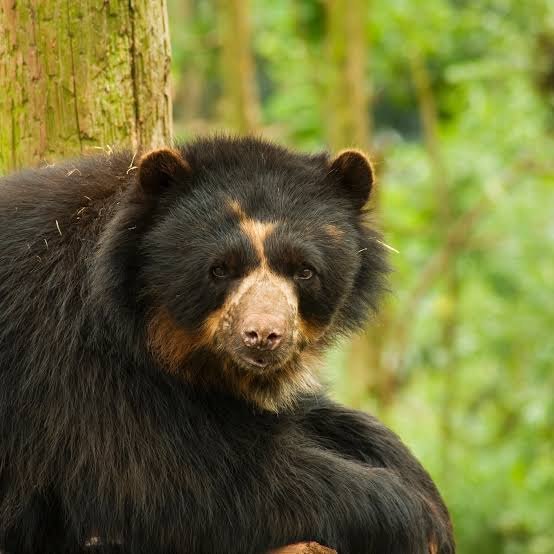
The pale facial markings that earned it the name spectacled bear are different on every individual.
In Colombia, the most robust estimate is from 2026. The National Natural Parks service, together with the organizations ABCA and WCS, used occupancy models, a technique that estimates bear presence from signs and camera traps without needing to see the animals directly. The result was 4,100 to 10,700 bears in the areas where the species has been detected, of which 2,000 to 5,100 would be within the landscapes prioritized for its conservation. Local studies found densities of 2.9 to 7.4 bears per 100 km², and the species is present in 23 of the country’s 61 national parks.
It is good news that there is finally a common method. But the range is still huge: the high figure is more than double the low one. For a species that reproduces slowly, that uncertainty matters.
Why the Andean Bear Matters
The Andean bear is more than a charismatic animal. It is what biologists call an umbrella species: it needs such large and diverse territories that protecting it also protects hundreds of other species living in the same forests and páramos.
It is also a seed disperser. By eating fruit and moving across the mountains, it plants the forest. And its home overlaps with the country’s water factories: the páramos and high Andean forests that supply much of the water used by cities like Bogotá. A healthy bear in the mountains is a sign that this water factory is still working.
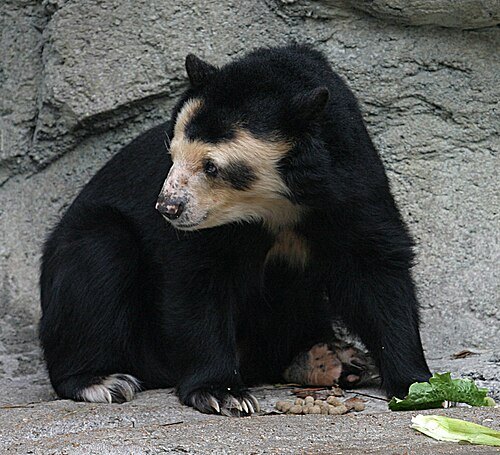
Although classified as a carnivore, the Andean bear eats mostly plants: fruit, bromeliads, leaves and shoots. Pictured: a bear at the Houston Zoo, USA. Photo: Cburnett / Wikimedia Commons.
The Risks: a Habitat Broken into Pieces
There is no single threat. It is the combination of forest loss, fragmentation and hunting.
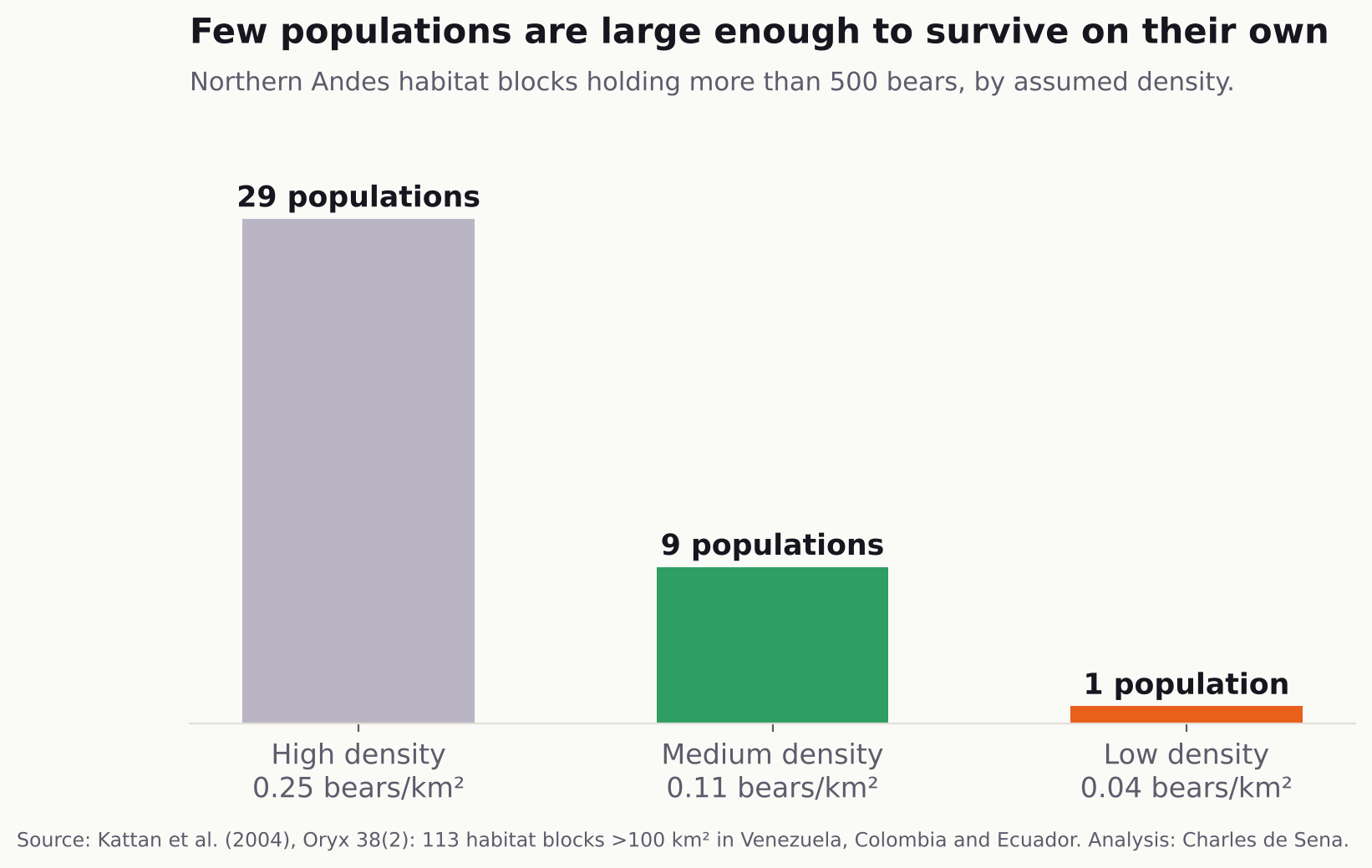
Fragmentation. In the northern Andes (Venezuela, Colombia and Ecuador), the bear’s habitat has been split into 113 blocks larger than 100 km², which together make up only 42% of its original extent. Forty percent of those blocks are smaller than 500 km², and only nine exceed 5,000 km². The IUCN also notes that key habitat patches shrank by 28.5% over 20 years.
The size of each block determines whether the population living in it can survive on its own. Assuming a medium bear density, only nine blocks would hold more than 500 bears. At a low density, only one would.
Retaliatory killing. When forest turns into pasture, bears and cattle start sharing territory. Some bears attack livestock or eat crops, and the response is often a gunshot. WCS biologists say that in departments such as Cauca, Arauca and Cundinamarca, bears are still being hunted.
Little formal protection. According to a 1998 analysis cited in Oryx, less than a fifth of the bear’s range lies within protected areas, and many of those areas are too small to sustain a viable population.
The Case of Antioquia
Antioquia, the department whose capital is Medellín, shows both sides of the problem. In Antioquia’s Western Cordillera, agricultural expansion has destroyed about 75% of the forest, according to Mongabay, and conflict between people and wildlife is common.
But there are also signs of a comeback. In 2014, researchers reported the possible return of the bear to northern Antioquia after 200 years without records. Between 2023 and 2024, camera traps documented it in the municipality of Salgar, in the southwest, and environmental authorities from the Aburrá Valley have responded to sightings in towns such as Andes and Segovia.
A bear showing up doesn’t mean it is safe. Often it shows up because its forest is shrinking and it has to move closer to farms.
What Works
The evidence shows that coexistence is possible when conservation is done with communities, not against them. In El Águila, in Valle del Cauca, coffee growers who used to be in conflict with the bear together set aside about 400 hectares for its protection. In Antioquia’s Western Cordillera, a local organization reduced conflicts between communities and wildlife through dialogue and community monitoring. And the Conservamos la Vida strategy, led by the National Parks service with private partners, has just completed a decade with more than 10,000 hectares restored.
Three Questions to Think About
1. Can we protect what we can’t count? Occupancy modeling is a step forward. The next step is to publish that data openly and regularly, so universities, regional authorities and citizens can follow the trend.
2. Who pays the cost of living with bears? Today, the cost of a dead cow falls on the small farmer. Without fast compensation and alternative livelihoods, retaliatory killing will remain the quickest response.
3. Are we connecting the pieces? Protecting isolated parks isn’t enough if forest blocks remain separated by pastures and roads. Wildlife corridors matter as much as protected areas.
Conclusion
The Andean bear sums up a problem that repeats itself in many public policies: we act urgently on something we measure poorly. In a decade, the figures being cited went from 700 to a range of up to 10,700, not because bears multiplied, but because the way of counting them improved.
The good news is that there is better data today, along with experiences proving that coexistence works. What’s missing is for that data to be open, comparable over time and used to decide where to protect, where to connect and whom to support. Caring for the bear means caring for the water of the Andes.
Methodology and Sources
- Species records: GBIF.org, live query for Tremarctos ornatus (taxonKey 2433401), only records with coordinates and no geospatial issues. The map’s counts update every time the page is opened.
- Conservation status: Velez-Liendo, X. & García-Rangel, S. (2017). Tremarctos ornatus. The IUCN Red List of Threatened Species 2017.
- 2026 estimate: Colombian National Natural Parks, ABCA and WCS, occupancy models (statements by the director of National Parks, July 2026).
- Earlier estimates: La República (April 2016), AFP/WWF (2017).
- Fragmentation and viability: Kattan, G. et al. (2004). Range fragmentation in the spectacled bear Tremarctos ornatus in the northern Andes. Oryx, 38(2), 155–163.
- Antioquia: Arias-Alzate & Acevedo-Quintero (2014) and Montoya-Osorio et al. (2025), Mammalogy Notes; Mongabay (2023).
- Coexistence: AFP (2023, El Águila), El País (2026, Conservamos la Vida strategy).
- Photos: Andean bears at the Curitiba Zoo (Brazil) and the Houston Zoo (USA, Cburnett), via Wikimedia Commons. All photos show captive animals.
The charts and map may be reproduced by media outlets with credit: Analysis: Charles de Sena using data from GBIF, the IUCN and Colombia’s National Natural Parks.